Predictions & Data for this entry
| Model: sbp | climate: A, BSh, Cfa, Cfb | migrate: | phylum: |
| COMPLETE = 4.5 | ecozone: TP | food: biHl, biHs | class: |
| MRE = 0.216 | habitat: 0iTf, 0iTi | gender: Dg | order: |
| SMSE = 0.083 | embryo: Ts, Th | reprod: O, Ap | family: |
Zero-variate data
Uni- and bivariate data
| Data | Figure | Independent variable | Dependent variable | (RE) | Reference |
|---|---|---|---|---|---|
| tN_36 |  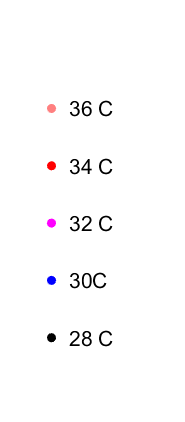 | time since birth | cumulative reproduction | (9.961) | ManiKenn2015 |
| tN_34 | | time since birth | cumulative reproduction | (7.461) | ManiKenn2015 |
| tN_32 | | time since birth | cumulative reproduction | (3.394) | ManiKenn2015 |
| tN_30 | | time since birth | cumulative reproduction | (0.4273) | ManiKenn2015 |
| tN_28 | | time since birth | cumulative reproduction | (3.651) | ManiKenn2015 |
| tS_36 |  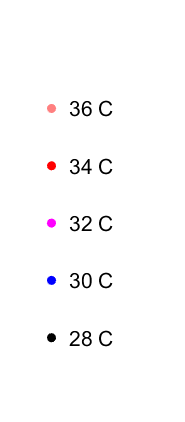 | time since puberty | survival | (128.6) | ManiKenn2015 |
| tS_34 | | time since puberty | survival | (49.28) | ManiKenn2015 |
| tS_32 | | time since puberty | survival | (13.23) | ManiKenn2015 |
| tS_30 | | time since puberty | survival | (0.296) | ManiKenn2015 |
| tS_28 | | time since puberty | survival | (14.77) | ManiKenn2015 |
| tN_HuChi |   | time since birth | cumulative reproduction | (0.4961) | HuChi2010 |
| tN_QuaiAnsa | | time since birth | cumulative reproduction | (0.2927) | QuaiAnsa2019 |
| tS_HuChi |  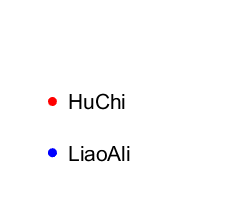 | time since birth | survival | (0.1627) | LiaoAli2019 |
| tS_LiaoAli | | time since birth | survival | (0.2715) | LiaoAli2019 |
| Tt1_SujiChan |  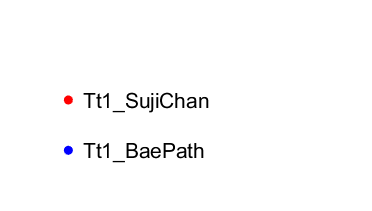 | temperature | 1st instar duration | (0.1452) | SujiChan2013 |
| Tt1_BaePath | | temperature | 1st instar duration | (0.1275) | BaePath1970 |
| Tt2_SujiChan |   | temperature | 2nd instar duration | (0.1668) | SujiChan2013 |
| Tt2_BaePath | | temperature | 2nd instar duration | (0.347) | BaePath1970 |
| Tt3_SujiChan |   | temperature | 3rd instar duration | (0.2022) | SujiChan2013 |
| Tt3_BaePath | | temperature | 3rd instar duration | (0.1147) | BaePath1970 |
| Tt4_SujiChan |   | temperature | 4th instar duration | (0.1648) | SujiChan2013 |
| Tt4_BaePath | | temperature | 4th instar duration | (0.1969) | BaePath1970 |
| Tt5_SujiChan |   | temperature | 5th instar duration | (0.2656) | SujiChan2013 |
| Tt5_BaePath | | temperature | 5th instar duration | (0.1957) | BaePath1970 |
| Tt0R_MochOkad |   | temperature | pre-oviposition period | (0.2104) | MochOkad1979 |
| Tt0R_ManiKenn | | temperature | pre-oviposition period | (2.274) | ManiKenn2015 |
| Tah |  | temperature | age at hatching | (0.2223) | MochOkad1979 |
| Tt_em |  | temperature | average life span as imago | (1.576) | SujiChan2013 |
| Ttb0R |  | temperature | time since birth at first oviposition | (1.895) | ManiKenn2015 |
| Ttp |  | temperature | time since birth at puberty | (0.1619) | MochOkad1979 |
| tWw |  | time since 5th instar ecdysis | wet weight | (0.07738) | LuoZhan2024 |
Pseudo-data at Tref = 20°C
| Data | Generalised animal | Nilaparvata lugens | Unit | Description |
|---|---|---|---|---|
| v | 0.02 | 0.002134 | cm/d | energy conductance |
| p_M | 18 | 45.73 | J/d.cm^3 | vol-spec som maint |
| k_J | 0.002 | 0.002 | 1/d | maturity maint rate coefficient |
| k | 0.3 | 0.1924 | - | maintenance ratio |
| kap | 0.8 | 0.6977 | - | allocation fraction to soma |
| kap_G | 0.8 | 0.8083 | - | growth efficiency |
| kap_R | 0.95 | 0.95 | - | reproduction efficiency |
| s_s | 0.01 | 1.612e-11 | - | supply stress |
Discussion
- Zerovariate data was centered around data that uses TN1 as food source, which is most frequently used; the TN1 data is used as reference point (f = 1); also includes studies in which the rice line had not been specified
- In the absence of further data, we assume age at birth (onset of feeding) to be equivalent to age at hatching (ah = tb)
- Entry uses female brachypterous (short-winged) form as reference and macropterous (long-winged) as deviation from the reference; if form is not specified in the data/predictions, it is related to the brachypterous form or the form was not specified in the literature; if brachypterous form is explicitly indicated, it belongs to a data pair for which we have data on both forms from the same study
- Egg weight was roughly approximated by obtained taking the extreme values for egg volume [reported in figure 2](https://www.frontiersin.org/journals/physiology/articles/10.3389/fphys.2020.00106/full) and converting them to wet weight, assuming a density of 1 mg/mm^3; this estimate was included because the implied E_0 could otherwise be orders of magnitude too high
- Entry does not explicitly deal with sexual reproduction; All reported reproduction values are eggs/female
- At high temperatures, survival follows a different temperature response than development rates, suggesting additional physiological stress; this issue deserves further investigation
- Macropterous imagos are assumed to differ from brachopterous form by p_M; This explains differences in reproductive output, but not in longevity; A large difference in p_M has to be assumed in order to explain the differences
- Data from ManiKenn2015 is reported, but not included in the fitting; the temporal references are not fully clarified and a separate f is not sufficient to include the data properly
- Separate f values for different rice lines had been implemented, but fixed to 1, since the estimates tended to be very close to 1 for the given data
- Reproduction period for HuChi2010 and QuaiAnsa2019 are based the corresponding tN data (time from first to last oviposition); these values are much higher than reproduction periods from XuShu2019 and ZhanMao2018; discrepancies may also arise from tN being averaged across individuals
- The ODE definition used in the predict file was adopted from Nezara viridula, with removal of the assumption of non-feeding first larval instars
- Life span as imago for SujiChan at 28 degC (8.3 d) is much lower than values from other studies at comparable temp. (e.g. LiChen, 28 degC: 20.3 d, LiuZhua, 28 degC: 16.05 d). The reasons are unclear
- Obtained relatively high value of z; limiting z to lower values did not result in a satisifiable fit; interpretation of z for models with cut-off growth curve is not identical to standard model
Acknowledgment
- The creation of this entry was financially supported by Bayer AG
Bibliography