Predictions & Data for this entry
| Model: std | climate: Aw, BWh, BSh, Cwa, Cwb | migrate: | phylum: |
| COMPLETE = 2.5 | ecozone: TPa | food: biO | class: |
| MRE = 0.050 | habitat: 0bTd, biFp, biFm | gender: Dtmf | order: |
| SMSE = 0.009 | embryo: Tt | reprod: O | family: |
Zero-variate data
| Data | Observed | Predicted | (RE) | Unit | Description | Reference |
|---|---|---|---|---|---|---|
| ab | 55 | 59.08 | (0.07426) | d | age at birth | pelomedusa |
| tp | 1460 | 1365 | (0.06504) | d | time since birth at puberty | guess |
| am | 7337 | 7337 | (1.229e-05) | d | life span | AnAge |
| Lb | 3.75 | 3.687 | (0.01671) | cm | carapace length at birth | pelomedusa |
| Lp | 12 | 12.1 | (0.008014) | cm | carapace length at puberty | pelomedusa |
| Li | 32.5 | 32.17 | (0.0102) | cm | ultimate carapace length | Wiki |
| Wwb | 3.84 | 3.702 | (0.03592) | g | wet weight at birth | pelomedusa, field_guide |
| Wwp | 126 | 130.7 | (0.03724) | g | wet weight at puberty | pelomedusa, field_guide |
| Wwi | 2500 | 2458 | (0.01676) | g | ultimate wet weight | field_guide |
Uni- and bivariate data
| Data | Figure | Independent variable | Dependent variable | (RE) | Reference |
|---|---|---|---|---|---|
| LN | 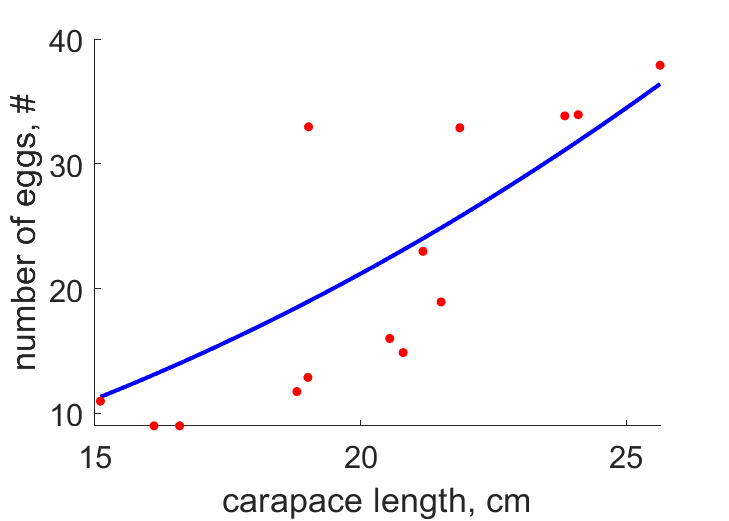 | carapace length | number of eggs | (0.2399) | Stry2001 |
Pseudo-data at Tref = 20°C
| Data | Generalised animal | Pelomedusa subrufa | Unit | Description |
|---|---|---|---|---|
| v | 0.02 | 0.04423 | cm/d | energy conductance |
| kap | 0.8 | 0.6474 | - | allocation fraction to soma |
| kap_R | 0.95 | 0.95 | - | reproduction efficiency |
| p_M | 18 | 3.618 | J/d.cm^3 | vol-spec som maint |
| k_J | 0.002 | 0.000139 | 1/d | maturity maint rate coefficient |
| kap_G | 0.8 | 0.7985 | - | growth efficiency |
| k | 0.3 | 0.3019 | - | maintenance ratio |
Discussion
- In view of low somatic maintenance, pseudodata k_J = 0.002 1/d is replaced by pseudodata k = 0.3
Facts
- Males are larger than females (Ref: Stry2001)
- Does not have a hinged plastron (Ref: Wiki)
- Removes ticks and blood-sucking flies from the bodies of warthogs, Cape buffalo and rhinoceroses (Ref: Wiki)
- Males and females have two small tentacles (of unknown function) beneath the chin, and musk glands beneath the fourth to eighth marginals (Ref: Stry2001)
Bibliography